
Walk into any D2C category today — skincare, wellness, nutraceuticals, home décor, fashion — and you’ll find the same story repeating itself. A founder launches with a genuinely good product, runs a few Meta ads, sees an early spike in sales, and then watches the growth curve flatten within a couple of quarters. The product didn’t get worse. The market didn’t dry up. What usually happened is simpler: the brand treated marketing as a series of disconnected activities instead of building an actual system.
This guide is written for the founders and marketing leads who are past the “let’s just run some ads” stage and are ready to build a real D2C brand marketing strategy — one where branding, acquisition, retention, and automation reinforce each other instead of competing for the same rupee of budget. We’ll go deep into each pillar, share the reasoning behind the tactics (not just a checklist), and end with a practical framework you can apply this quarter.
The Core Problem With Most D2C Marketing Today
Before getting into tactics, it’s worth naming the problem plainly: most D2C brands are acquisition-obsessed and retention-starved. Founders pour 80–90% of their marketing budget and attention into Meta and Google ads chasing new customers, while the systems that keep those customers coming back — CRM flows, loyalty mechanics, post-purchase communication — get built as an afterthought, if at all.
The financial consequence is predictable. As competition for ad inventory increases, cost-per-acquisition (CPA) rises steadily, sometimes 20–40% year-on-year in saturated categories like skincare and supplements. If a brand’s average order value and repeat purchase rate stay flat while CPA climbs, unit economics quietly break — even while top-line revenue looks like it’s growing. This is why so many D2C brands raise funding, spend aggressively on ads, and still struggle to reach profitability.
The fix isn’t “spend less on ads.” It’s building a marketing system where acquisition and retention share the workload — so the brand isn’t permanently dependent on ever-increasing ad spend to hit the same revenue number.
The Six Pillars of a High-Performing D2C Brand Marketing Strategy
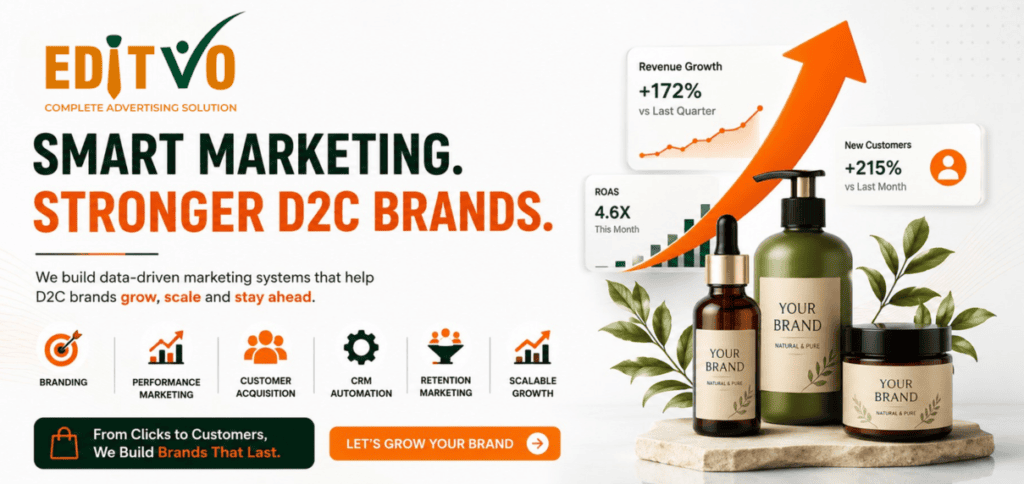
A sustainable D2C growth engine rests on six pillars that need to function as one connected system, not six separate departments:
- Branding — the trust layer that lowers resistance to every future ad
- Performance Marketing — the acquisition engine that drives immediate, trackable demand
- Customer Acquisition Strategy — the full-funnel approach that turns strangers into buyers
- CRM Automation — the infrastructure that personalizes communication at scale
- Retention Marketing — the layer that turns one-time buyers into repeat revenue
- Scalable Growth Systems — the operating rhythm that makes results repeatable, not accidental
Brands that build all six in parallel tend to report a very different growth pattern than brands chasing ads alone — often in the range of 4–5X return on ad spend (ROAS), sustained quarter-on-quarter revenue growth well above category averages, and new-customer growth that compounds instead of plateauing after the first big campaign push. These aren’t magic numbers; they’re what happens naturally when acquisition cost is offset by rising customer lifetime value (LTV).
1. Branding: Why It’s an Acquisition Cost Reducer, Not Just a Design Exercise
Founders often treat branding as the “nice to have” that gets attention only after the ads are already running. This is backwards. In performance marketing, ad platforms reward relevance and engagement — and a recognizable, trustworthy brand simply performs better in an auction than a generic one, because people click, save, and convert at higher rates when something already feels familiar or credible.
A strong D2C branding foundation includes:
Category positioning. What specific problem does this product solve better than the five other options in the same shelf or search result? “Natural skincare” is not a position; “fragrance-free skincare formulated for post-procedure sensitive skin” is. Specificity is what makes a brand memorable in a crowded feed.
Visual and packaging identity. In D2C, packaging often is the first ad creative — the same bottle photographed on a marble counter becomes the hero image in a Meta ad, a product page shot, and an unboxing reel. Consistency across these touchpoints compounds recognition over time.
Brand voice and tone. Whether the brand sounds clinical and expert-driven, warm and personal, or bold and disruptive should be a deliberate choice reflected consistently in ad copy, captions, and even customer service replies — not something that shifts depending on who’s writing that week.
Proof and storytelling. Ingredient sourcing, manufacturing process, founder story, or customer transformation stories all reduce the psychological “is this legit?” friction that D2C buyers feel before a first purchase, especially in categories like skincare, supplements, and wellness where trust is the biggest barrier to conversion.
Why this matters for performance marketing: A brand with strong positioning and creative consistency typically sees higher click-through rates and lower cost-per-click, because the ad platform’s algorithm optimizes toward engagement — and people engage more with brands that feel coherent and credible.
2. Performance Marketing: Building a Testing Engine, Not Just a Campaign
Performance marketing — primarily Meta Ads and Google Ads for most D2C brands, with YouTube and programmatic display growing in relevance — is where most of the acquisition budget lives. But there’s a meaningful difference between “running ads” and building a performance marketing system.
Full-funnel campaign architecture. Rather than running a single conversion campaign and hoping for the best, mature D2C brands structure campaigns across the funnel: cold-audience awareness and interest campaigns, mid-funnel consideration campaigns (retargeting website visitors, video viewers, engaged social followers), and bottom-funnel conversion and cart-abandonment campaigns. Each stage needs different creative and messaging — a cold audience needs a hook and a reason to care; a warm audience needs a nudge and an offer.
Creative testing as an ongoing habit. Ad fatigue is real — the same creative shown to the same audience for weeks sees declining click-through rates and rising costs. Brands that sustain strong ROAS treat creative production as continuous: testing new hooks, formats (UGC-style videos, static carousels, founder-led talking-head videos), and angles on a weekly or biweekly cadence, rather than producing one “hero” ad and running it for months.
Budget allocation based on data, not instinct. This means reviewing performance at the ad-set and creative level regularly, shifting budget toward what’s converting efficiently, and killing underperformers quickly rather than letting sentimental attachment to a “nice” creative drain the budget.
Landing page and product page optimization. Even a high-performing ad fails if it lands on a slow page, a confusing product description, or a checkout flow with unnecessary steps. Page load speed, clear value proposition above the fold, social proof (reviews, ratings, UGC), and a frictionless checkout are as much a part of performance marketing as the ad itself.
A note on ROAS benchmarks: A 4X+ ROAS is a strong outcome in many D2C categories, but the “right” number depends heavily on category margins — a premium skincare brand with 70% gross margin can profitably operate at a lower ROAS than a low-margin food or FMCG brand. Chasing a generic ROAS target without accounting for margin is one of the most common performance-marketing mistakes.
3. Customer Acquisition Strategy: The Full Path, Not Just the Ad Click
“Customer acquisition” gets used interchangeably with “running ads,” but a real acquisition strategy covers the entire journey from someone’s first impression of the brand to their first completed order.
Audience research grounded in existing data. Rather than starting with platform-suggested interest targeting, the strongest acquisition strategies start by studying who’s already buying — what they have in common, what content they engage with, what objections show up in customer service chats or reviews — and build lookalike and interest targeting from there.
Offer architecture. The first purchase is the hardest one to earn. Trial sizes, starter bundles, first-order discounts, and “buy one, gift one” mechanics all exist to lower the risk a first-time buyer feels. The offer strategy should evolve as the brand matures — heavy discounting to build an initial customer base is a different strategy than the offer mix used once a brand has strong repeat demand and reviews doing the trust-building instead.
Multi-channel presence that reinforces itself. A customer who sees a brand on Instagram, then searches for it on Google and finds a well-optimized listing and positive reviews, then sees a retargeting ad, converts at a meaningfully higher rate than someone who sees a single touchpoint. Meta, Google Search, influencer collaborations, and organic content should be coordinated to reinforce the same message rather than operating as isolated channels each claiming credit for the same sale.
Conversion rate optimization (CRO). Small, unglamorous fixes — clearer product photography, FAQs addressing real objections, visible return/refund policy, faster page load — often move conversion rate more than a bigger ad budget does. A brand converting at 2.5% instead of 1.5% effectively gets a 60%+ increase in output from the same ad spend, without touching the media budget at all.
4. CRM Automation: Personalization at a Scale Manual Effort Can’t Match
Once a brand has real order volume, following up with every lead, abandoned cart, or lapsed customer manually simply isn’t possible. CRM automation is the infrastructure that lets a small team deliver a personalized experience to thousands of customers simultaneously.
A well-built CRM automation setup typically includes:
- Abandoned cart and browse-abandonment flows — automated email/WhatsApp/SMS sequences triggered when someone adds to cart or views a product without purchasing, often recovering a meaningful share of otherwise-lost revenue.
- Behavioral segmentation — grouping customers by purchase history, browsing behavior, or engagement level so messaging is relevant rather than generic broadcast.
- Lifecycle-stage messaging — a welcome series for new subscribers, onboarding content for first-time buyers, and different messaging entirely for a customer on their fifth order.
- A feedback loop into paid media — CRM data (who are the highest-LTV customers, what do they have in common) feeding back into lookalike audiences for acquisition campaigns, so the acquisition engine gets smarter over time instead of guessing.
For Indian D2C brands specifically, WhatsApp automation has become a particularly high-leverage channel given open rates on WhatsApp typically far outperform email — making it a natural fit for order updates, replenishment reminders, and time-sensitive offers.
5. Retention Marketing: The Growth Lever Most D2C Brands Underuse
Acquiring a new customer is consistently more expensive than retaining an existing one — this holds true across virtually every D2C category, but it’s especially pronounced in consumable and replenishable products like skincare, supplements, and food, where a satisfied customer has an obvious, predictable reason to reorder.
Retention marketing is the deliberate system built to make that reorder happen without relying on the customer remembering on their own:
Post-purchase nurture sequences. The period right after a first purchase is a critical trust-building window — usage tips, how-to content, and check-ins (“how’s it working for you?”) reduce buyer’s remorse and build the habit that leads to a second purchase.
Replenishment and subscription mechanics. For consumable products, timing a reminder or offer around when the product is likely to run out — rather than a generic monthly blast — converts significantly better because it matches actual customer need.
Loyalty and referral programs. Rewarding repeat purchases and referrals turns existing customers into an acquisition channel of their own, often at a fraction of the cost of paid ads, and referred customers tend to convert and retain better because they arrive with built-in trust from the person who referred them.
Win-back campaigns. Customers who haven’t purchased in a while aren’t lost — they’re a segment that needs a specific reactivation offer or message, distinct from both new-customer acquisition and active-customer retention messaging.
Brands that invest seriously in retention typically see their new-customer acquisition numbers compound with repeat-purchase revenue rather than each cohort needing to be “re-won” from scratch — which is a major reason some D2C brands sustain triple-digit growth without a proportional increase in ad spend.
6. Scalable Growth Systems: Making Results Repeatable
The final pillar is what actually makes a D2C brand scalable rather than lucky. A brand that grows because one influencer collab went viral, or one campaign happened to hit at the right time, hasn’t built a system — it’s had a good month. Scalable growth means:
- Documented, repeatable processes for campaign launches, creative production, and reporting — so results don’t depend on one person’s institutional knowledge.
- Visible data dashboards tracking ROAS, CAC, LTV, and repeat purchase rate at a glance, so decisions are made on trends rather than gut feeling or the most recent good (or bad) week.
- Channel diversification so a single platform’s algorithm change, iOS privacy update, or CPM spike doesn’t threaten the entire business.
- A closed feedback loop where branding, acquisition, CRM, and retention data all inform each other — winning ad creative informs organic content, retention data informs acquisition targeting, and customer service feedback informs product and messaging decisions.
A Practical 90-Day Framework to Start Building This
If a full six-pillar system feels like a lot to build at once, here’s a realistic sequencing for the first 90 days:
Days 1–30: Foundation. Audit current branding consistency across ad creative, packaging, and website. Set up basic CRM flows (welcome series, abandoned cart) if they don’t already exist. Establish a reporting dashboard tracking ROAS, CAC, and repeat purchase rate as baseline numbers.
Days 31–60: Acquisition testing. Launch a structured full-funnel campaign (awareness, consideration, conversion) with at least 3–5 creative variations being tested simultaneously. Begin CRO fixes on the highest-traffic product pages.
Days 61–90: Retention build-out. Layer in replenishment reminders, a loyalty or referral mechanic, and win-back flows for lapsed customers. Review the first 60 days of acquisition data to refine targeting and feed learnings back into both ad creative and CRM segmentation.
By the end of this cycle, most D2C brands have enough data to see where the biggest gains are — sometimes it’s creative fatigue on the ad side, sometimes it’s a leaky checkout, and often it’s simply the absence of any retention system at all.
Frequently Asked Questions
What is the most important part of a D2C brand marketing strategy? There isn’t a single most important pillar — the strategy works because branding, acquisition, and retention reinforce each other. That said, most D2C brands get the most immediate return from fixing retention gaps, since it’s usually the most neglected pillar relative to how much revenue it can unlock.
How much should a D2C brand spend on performance marketing? This depends heavily on category margins and current CAC-to-LTV ratio, but a common approach is to fund performance marketing aggressively only once retention systems exist to capture repeat value — otherwise every rupee spent on acquisition has to work at full margin with no second-purchase upside.
Is CRM automation only useful for large D2C brands? No — even a lean, early-stage D2C brand benefits from basic automation like abandoned cart flows and a welcome series, since these require no manual effort once set up and typically recover revenue that would otherwise be lost entirely.
Building the System, Not Just the Campaign
The D2C brands that sustain growth year after year aren’t the ones with the single best ad or the most viral reel — they’re the ones that built branding, performance marketing, customer acquisition, CRM automation, and retention marketing as one connected system, with scalable growth as the outcome rather than the starting point.
If you’re a D2C brand looking to build exactly this kind of system, Editvo Complete Advertising Solution works with growing D2C brands on branding, performance marketing, CRM automation, and retention strategy — built to move brands from clicks to customers, and customers who stay.